





Those Nights at Rachel's
Those Nights at Rachel's is an early 3D free-roam FNAF fan game created by Nikson, the developer behind The Joy of Creation. The game places you inside a multi-station office where you move in real time, check systems, and watch animatronics travel through a dark environment. Its lighting changes the way each room feels, so a familiar route can become uncomfortable when visibility drops. For its release period, the project stood out among fan games that still followed the classic point-and-click camera format.
Those Nights at Rachel's helped move the FNAF fan-game scene toward larger 3D spaces and more active survival systems. The shift matters because you do not simply sit at one desk and switch between cameras. You walk, listen, turn toward different stations, and judge whether a short trip is worth the risk. The design has rough edges, as an older fan project naturally does, but its basic idea remains easy to recognize in later free-roam horror games.
Gameplay Objective
Gameplay Objective focuses on surviving each night while moving between stations, managing power or other systems, and tracking several animatronics across a three-dimensional map. You must remember where tools and monitoring points are located, then reach them without losing control of the situation. Timing still matters, but spatial awareness carries more weight than it does in a traditional FNAF office. A safe position can become unsafe when an animatronic changes direction or the room loses useful light.
Gameplay Objective feels more physical than the usual FNAF routine. Players decide when to leave a station, how far to travel, and whether they can afford a few seconds without direct monitoring. Staying still gives you more time to read cameras or lights, while moving gives you access to another part of the office. That choice creates the tension. Sometimes the correct move is obvious; other times, you are choosing between two bad options and hoping your route was fast enough.
Controls
Controls combine standard first-person or third-person movement with interaction keys for cameras, systems, doors, lights, or other stations. The exact layout can vary by version, so checking the in-game instructions before a serious attempt is useful. Movement has more weight here than in a pure point-and-click FNAF title. You need to face the right object, stop in a workable position, and complete the interaction before the threat reaches you.
Controls take a little time to feel natural, especially when the multi-station layout sends you across the same rooms repeatedly. Practice the main movement paths during the opening part of a night instead of waiting until an emergency. Learn where corners slow you down and which stations require a clean approach. This is a small habit, but it keeps panic from turning a simple task into a missed input.
FNAF Characters
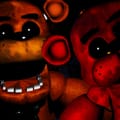
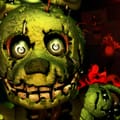
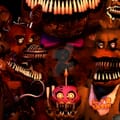
FNAF Characters in Those Nights at Rachel's use designs made for the Rachel’s setting rather than copying the standard cast in a simple office setup. Their threat comes from movement through shared 3D space. You may catch only a shape, a change in the room, or a brief glimpse before you need to check another station. That limited information makes each encounter less predictable than a fixed camera warning.
FNAF Characters also gain more presence from the real-time presentation. An animatronic crossing a hallway under uneven lighting feels different from an image appearing on a monitor. You can see part of the route, but rarely everything that matters. The effect is not always perfectly polished, and some encounters can feel unclear, yet that uncertainty fits the game’s atmosphere. Sound and motion often tell you more than a direct look.
Sound and Visuals
Sound Effects carry much of the warning system. Spatial audio, footsteps, mechanical noises, and changes in the surrounding environment can help you track a threat that is outside your view. Players who watch only the screen may miss information arriving from another direction. Keep the volume at a level where these cues remain distinct, because a loud visual effect does not always announce the danger that matters most.
Visuals were ambitious for their time within the FNAF fan-game community. Real-time lighting gives the office a stronger sense of distance and makes dark areas feel useful to the horror rather than merely decorative. Shadows can hide movement, while a sudden light can reveal a position you did not expect. The graphics are dated now, but the atmosphere still works when the lighting and sound line up. That combination remains one of the game’s better qualities.
Strategy Tips
Strategy Tips begin with learning efficient routes between stations and keeping track of every place you may need to visit. Do not spend too long in one area just because it feels familiar. Leave room for a retreat, and avoid walking into a corner without knowing how you will get back out. A simple route written in your head can save time when the night becomes noisy and your attention starts to split.
Strategy Tips also rely on sound as much as vision. Listen before leaving a station, then compare what you hear with what you know about the animatronics’ positions. Many failed attempts come from watching one screen too closely while ignoring an audio warning from another part of the office. Try to move with a purpose rather than wandering. Must you check everything immediately? No. Prioritize the system or route that presents the clearest danger, then return when the pressure drops.
Final Thoughts
Those Nights at Rachel's remains an important early 3D FNAF fan game for anyone interested in how the series’ fan projects expanded beyond static offices. Its free-roam movement, multi-station layout, lighting, and audio tracking give it a distinct place among older community releases. Some mechanics show their age, and the experience can be rough around the edges, but the design still has a clear identity. Players looking for the original release should check the official or archived Game Jolt listing, since availability can change over time.